Launch offer — valid today only

📄 Digital book in PDF · read it on your phone or print it

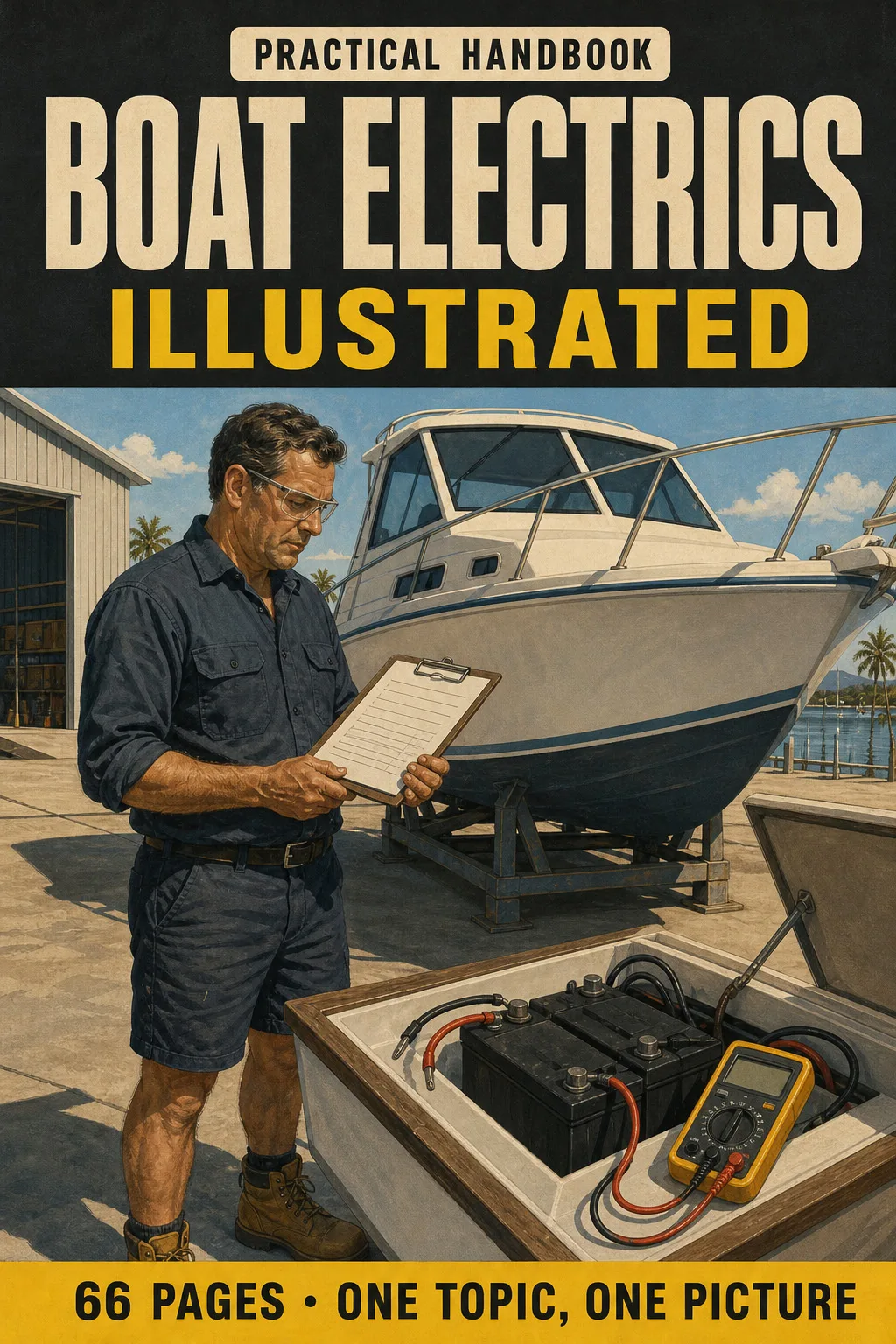
Your Boat's 12 V and 24 V DC System in Drawings One Topic on Every Page

Battery banks and lithium, cable sizing in mm², voltage drop, fuses and breakers, charging and solar, bilge pumps, nav lights and fault finding. Each topic gets its own page: the drawing first, then what you need to remember. 66 illustrated pages.

SHOW ME MY BOAT'S WIRING, DRAWN

🔒 Secure checkout · PDF by email · 30-day guarantee

Every topic, its own pageEvery circuit drawn on the same block diagram, with the explanation beside it
66 illustrated pages8 parts, from your boat as one simple diagram to the whole system on one page
Up-to-date sourcesFollows AS/NZS 3004.2, the Australian and NZ standard for electrics on recreational boats, plus state maritime rules for nav lights
PDF by emailFormat

Look Inside the Book

Every page has one big drawing and a box with the numbers and rules you need to know:

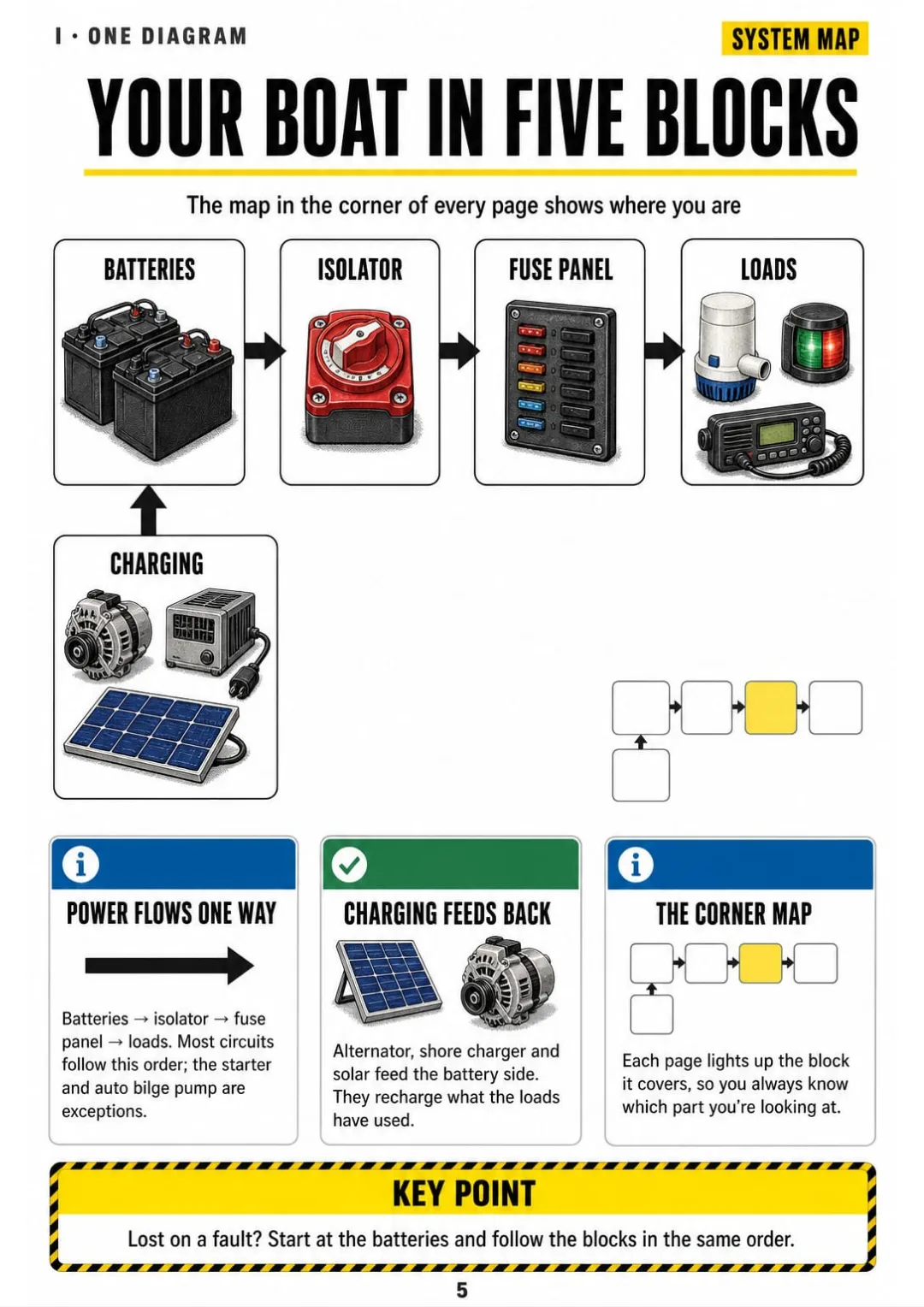
Batteries → isolator → fuse panel → loads, with charging feeding back: the map on every page
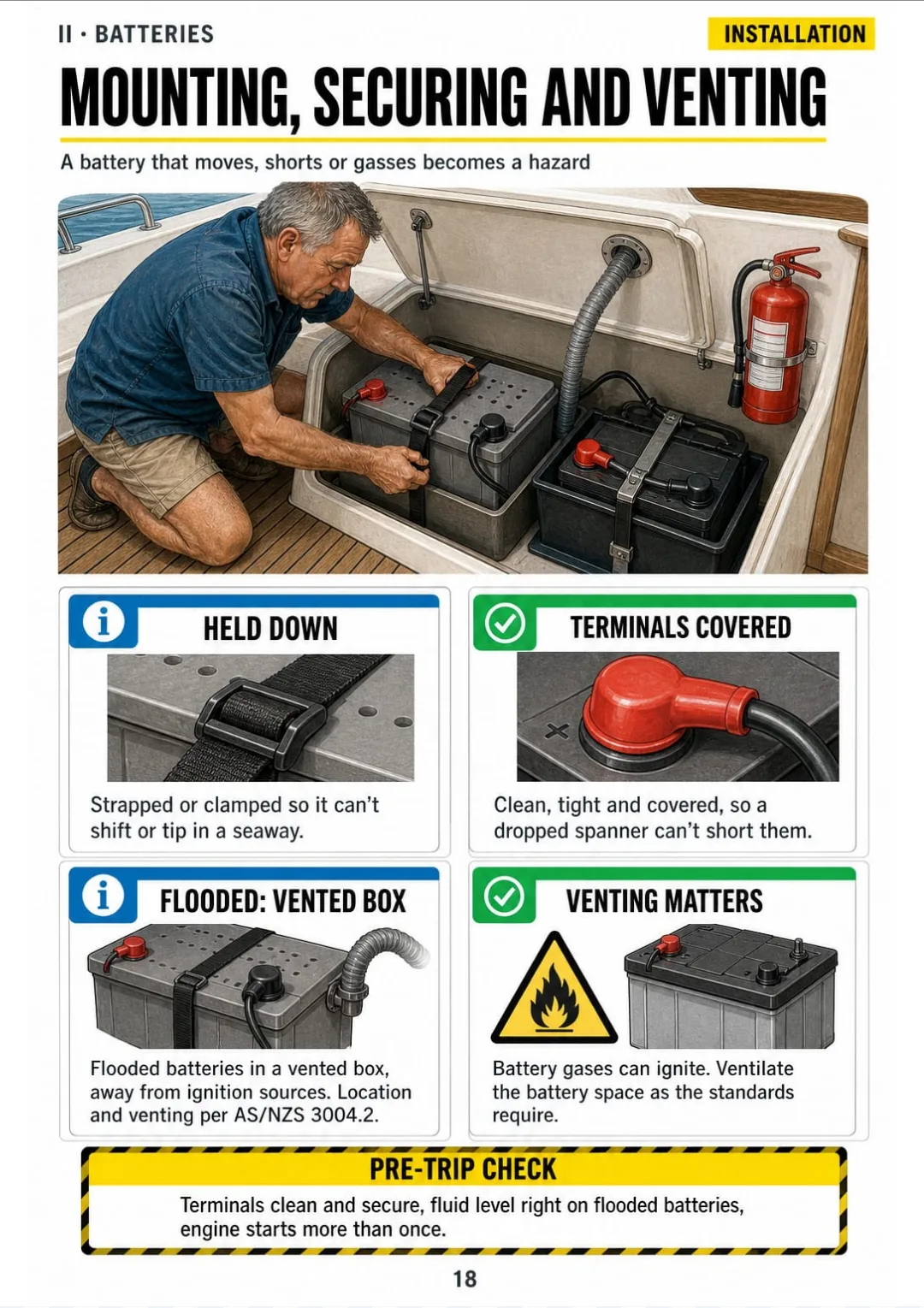
Strapped down, terminals covered, flooded batteries in a vented box away from sparks.
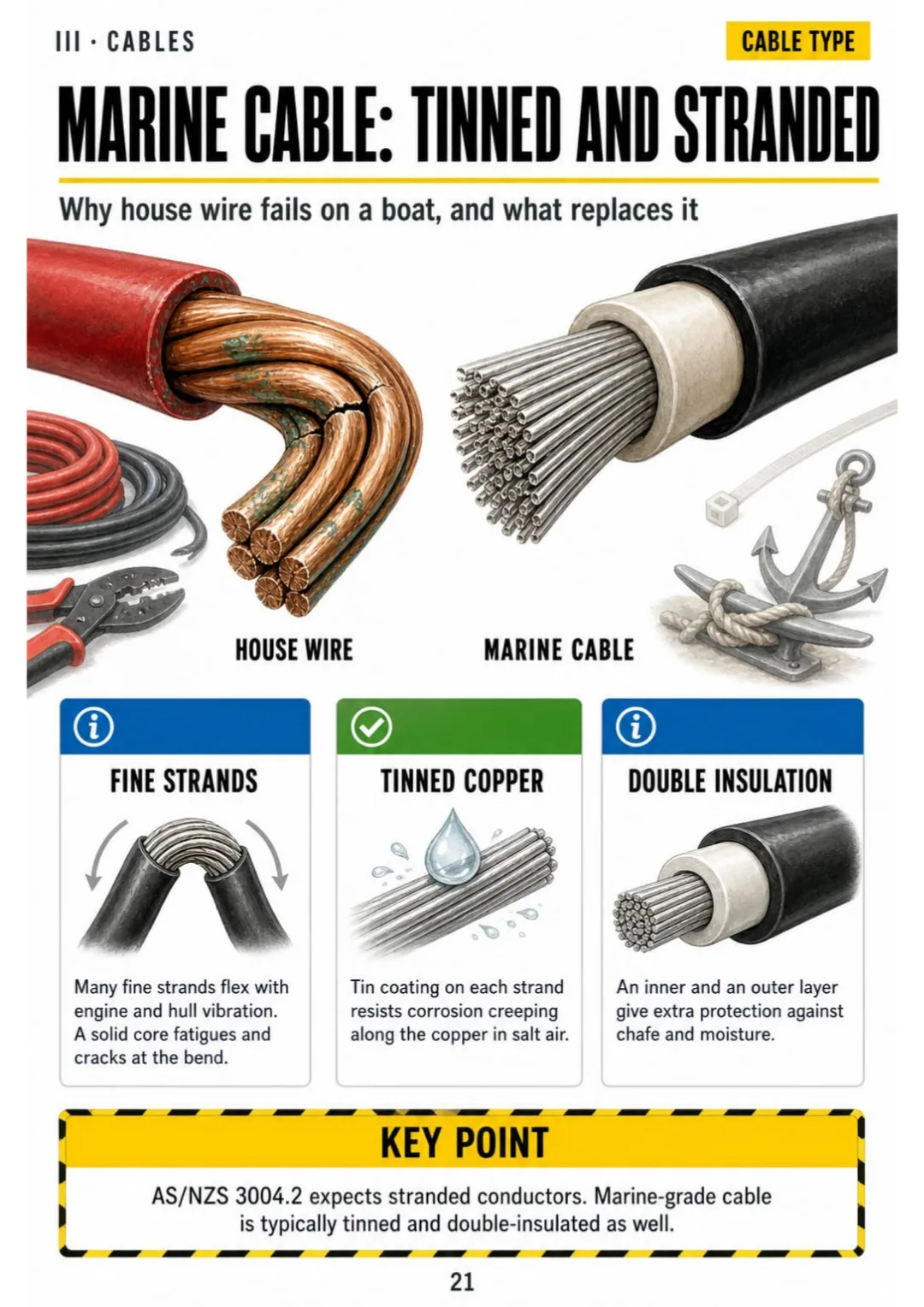
Fine-stranded, tinned, double-insulated: why marine cable survives vibration and salt air
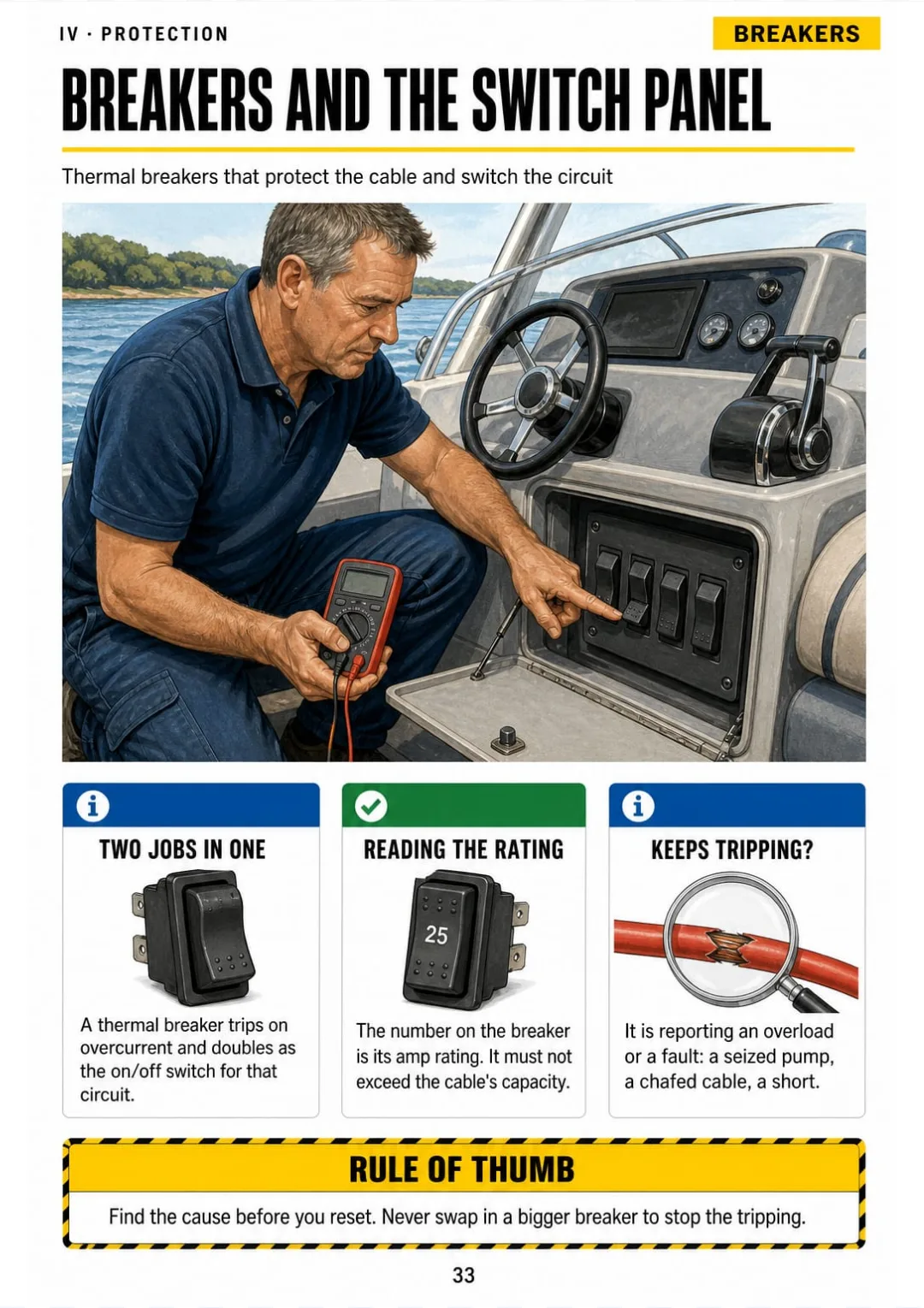
Breaker rating sized to the cable; repeated tripping means find the fault.
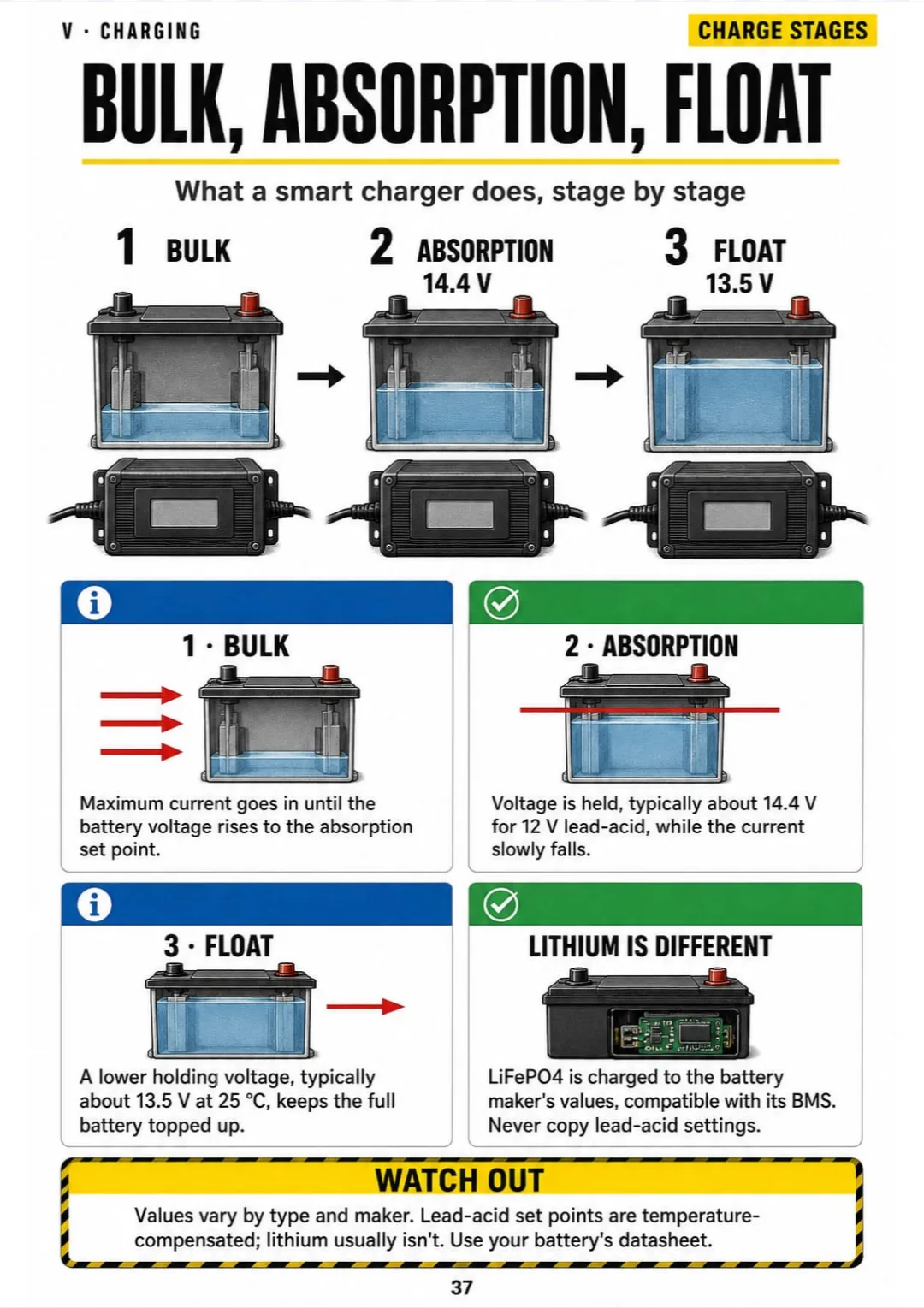
Bulk, absorption about 14.4 V, float about 13.5 V: typical 12 V lead-acid, at 25 °C
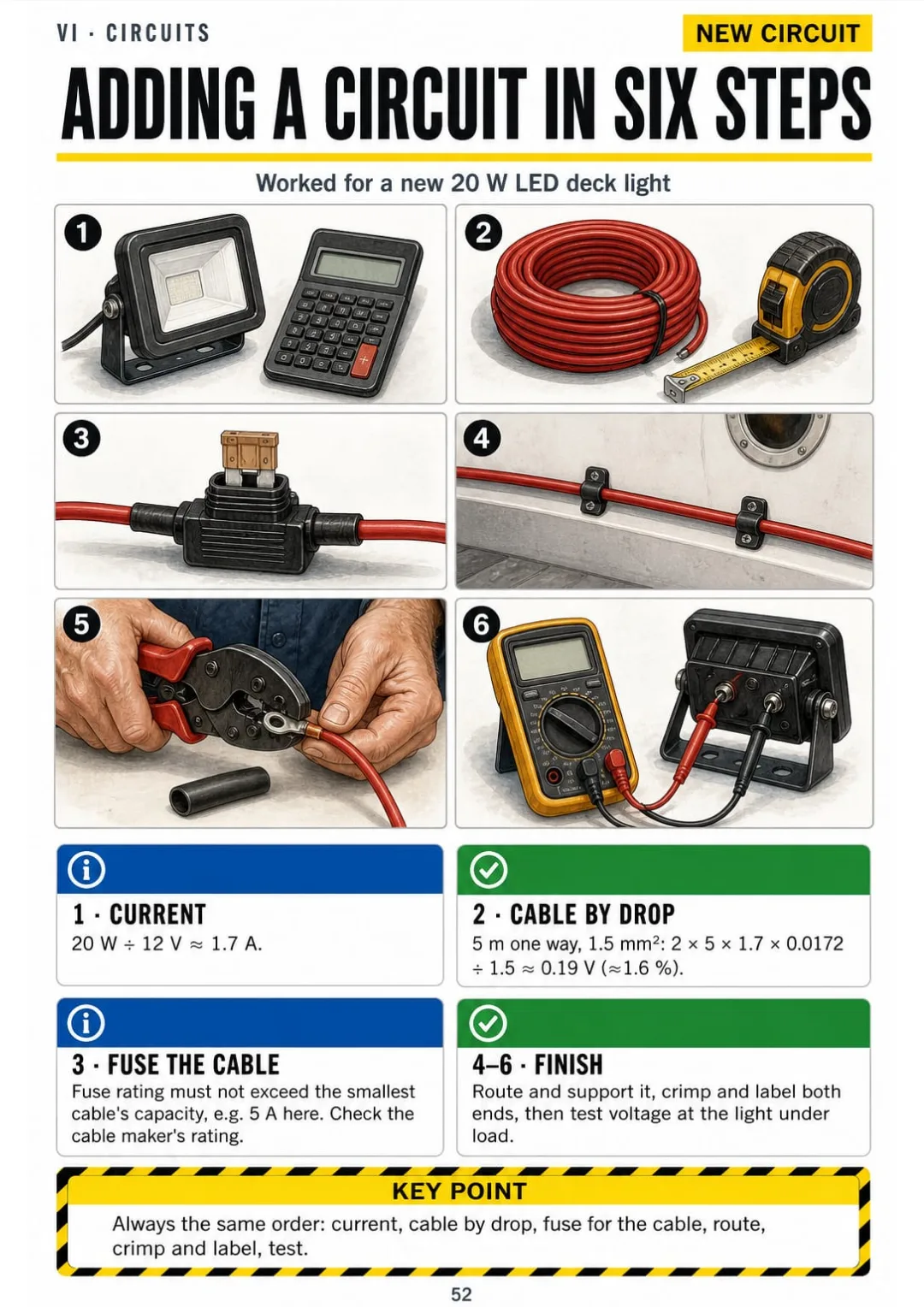
20 W deck light: 1.7 A, 1.5 mm² for 5 m gives about 1.6 % drop.
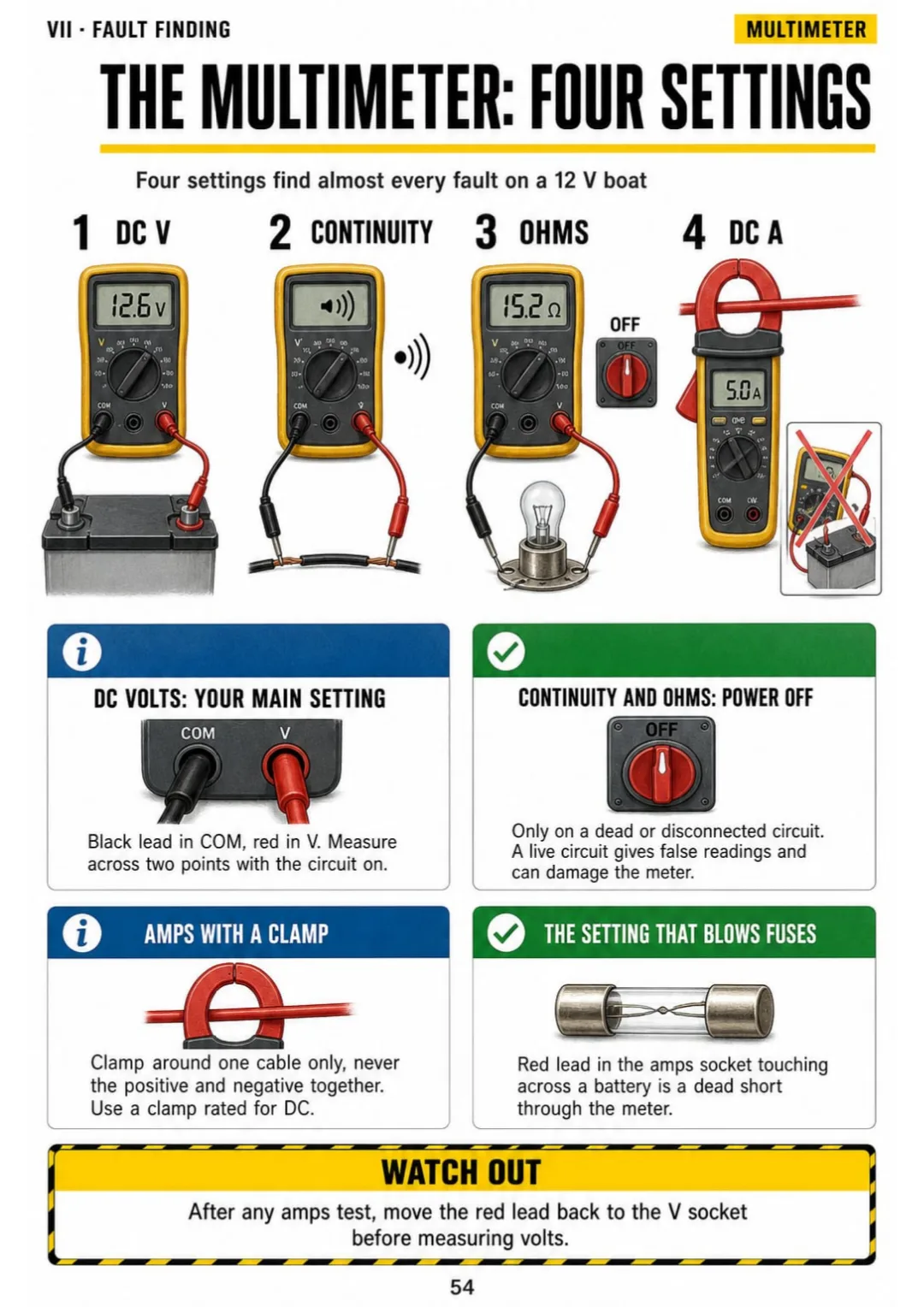
DC volts, continuity, ohms on a dead circuit, and DC amps with a clamp meter
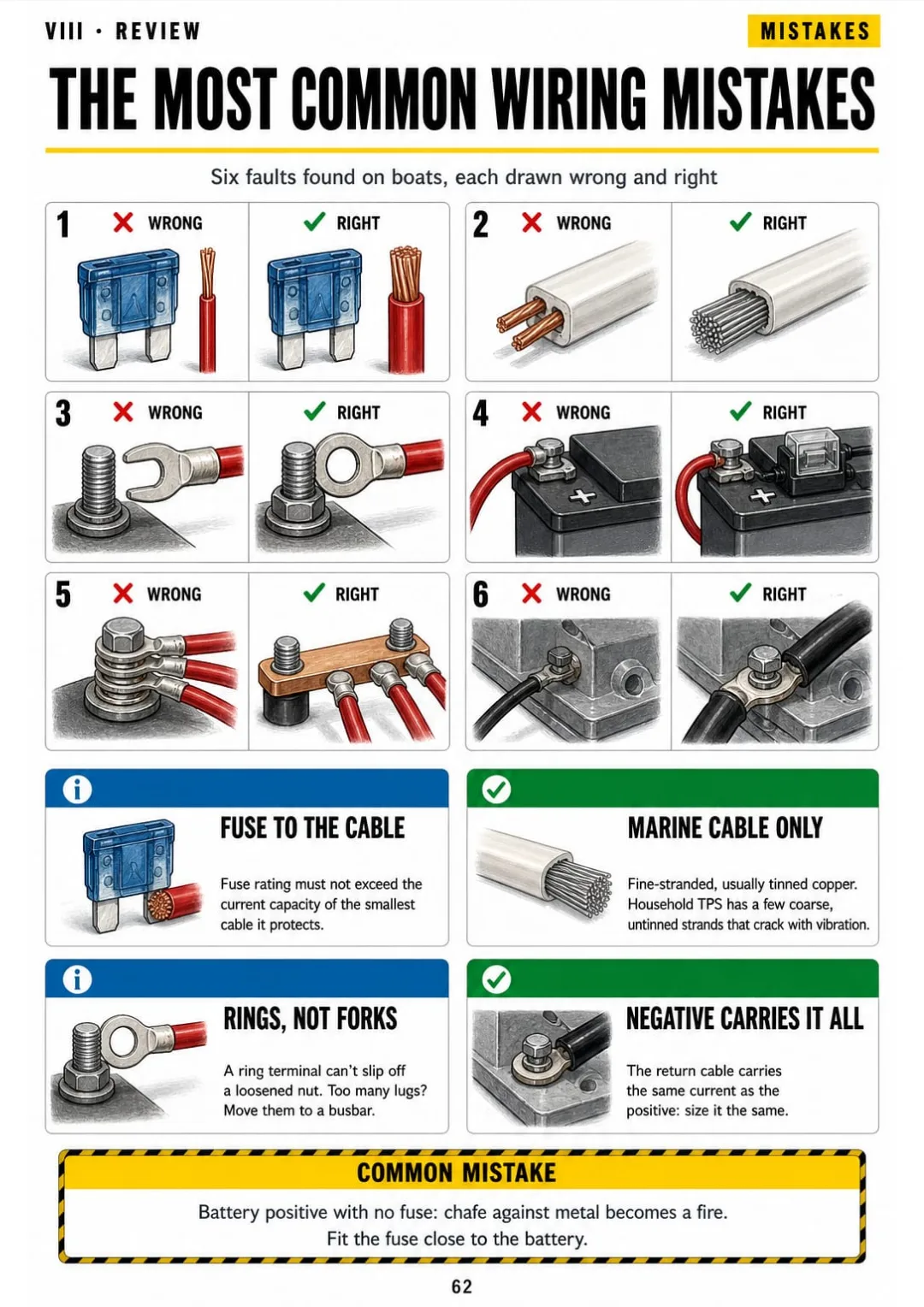
Six classic faults side by side: wrong on the left, right on the right

Swipe to see more →

These are real pages from the book. The table of contents is the full one: 8 parts and 62 topics.

The Problem Isn't You. It's How It Was Explained.

You're at the chandlery with a new bilge pump under your arm, looking at a wall of cable reels. The automotive cable is right there and it looks the same. Will it do the job on a boat?

You've looked it up before. The manual answers in long paragraphs about strand classes and conductor coatings, and the forums answer in AWG. You end up knowing more words, but not which reel to buy.

Fine-stranded, tinned, double-insulated: why marine cable survives vibration and salt air

In this book, marine cable is one page. The cable is drawn cut open: fine strands, each one tinned, two layers of insulation. Next to it, plain copper turning green in salt air and a solid core cracking from vibration. You see why at a glance.

Every other topic gets the same treatment: start and house batteries, where the fuse goes, the three charge stages, the bilge pump circuit, the four multimeter settings.

So you pick the right reel and you know why. No manual in your pocket, no guessing at the counter.

COMPARE FOR YOURSELF

The Same Topic, Two Ways to Learn It

THIS
  • The manual: line after line
  • Battery types explained only in words
  • You get back to the boat still unsure
Lead-acid batteries intended for marine service are generally classified according to their design purpose. Engine-starting batteries employ a greater number of thinner plates in order to maximise active surface area, enabling the delivery of high current for short durations, normally specified in cold cranking amps. Deep-cycle or house batteries utilise thicker plates and denser active material, providing sustained current over extended periods, specified in ampere-hours at a nominated discharge rate. Repeated deep discharge of a starting battery will result in plate degradation and premature loss of capacity.
FOR THIS
  • Start and house batteries in one drawing
  • CCA and Ah in a box
  • You see it and it makes sense
Strapped down, terminals covered, flooded batteries in a vented box away from sparks.
CONTENTS

Take a Look at the 8 Parts and 62 Topics

Your boat as one diagram, batteries and the bank, cables and connections, fuses and protection, charging and solar, the circuits on board, fault finding and the review checklists: 66 pages, all illustrated

IYour boat as one simple diagram · pp. 5-11
  1. The block diagram you'll see on every page
  2. Volts, amps and ohms as water in a hose
  3. Ohm's law in one triangle
  4. Watts and amp-hours: what a load really costs your battery
  5. 12 V or 24 V: why bigger boats double up
  6. A circuit is a loop: positive out, negative back
  7. DC and 230 V AC on the same boat
IIBatteries and the battery bank · pp. 12-20
  1. Start battery and house battery: two different jobs
  2. Flooded, AGM, gel and lithium side by side
  3. Reading state of charge with a voltmeter
  4. Usable capacity: the 50 % rule and the lithium difference
  5. Sizing a house bank from your daily load
  6. Series and parallel drawn
  7. Mounting, securing and venting batteries
  8. Battery isolator switches: 1-2-Both-Off and dual-circuit
  9. Moving to lithium: what changes on your boat
IIICables, terminals and connections · pp. 21-29
  1. Marine cable: tinned, stranded, double-insulated
  2. mm², not AWG: reading a cable size
  3. Current capacity: how many amps a cable can carry
  4. Voltage drop: the formula in mm²
  5. Voltage drop worked: the bilge pump run
  6. Colour coding so the next person can follow it
  7. Crimping a terminal properly
  8. Ring terminals, studs and stacking limits
  9. Routing and supporting cable
IVFuses, breakers and protection · pp. 30-36
  1. A fuse protects the cable, not the device
  2. Fuse close to the battery
  3. Fuse types drawn: blade, ANL, MIDI, MRBF, Class T
  4. Circuit breakers and the switch panel
  5. Busbars and the negative side
  6. Ignition protection in petrol engine spaces
  7. Corrosion, bonding and anodes in one page
VCharging: alternator, charger and solar · pp. 37-45
  1. The three charge stages: bulk, absorption, float
  2. The alternator: what it can and can't do
  3. Charging two banks: VSR, relay or DC-DC charger
  4. Shore-power battery charger
  5. Solar on a boat: panel, regulator, battery
  6. PWM or MPPT
  7. Solar sizing worked for Australian sun
  8. Battery monitors and shunts
  9. Inverters: 230 V from your 12 V bank
VIThe circuits on your boat · pp. 46-53
  1. Bilge pump wiring: auto, manual and float switch
  2. Bilge pump sizing and the litres-per-hour trap
  3. Navigation lights for small craft
  4. Interior and deck lighting: changing to LED
  5. VHF, sounder and chartplotter
  6. Fridge and the biggest load on board
  7. Adding a new circuit the right way
  8. Tinnies and trailer boats: the small-boat version
VIIFault finding, always in the same order · pp. 54-61
  1. The multimeter: four settings you actually use
  2. The method: from the battery to the load
  3. Voltage drop testing under load
  4. The fuse that 'looks fine'
  5. Fault worked: the bilge pump that won't run
  6. Fault worked: flat start battery after a week on the mooring
  7. Fault worked: flickering nav light
  8. Before you switch back on
VIIIReview and checklists · pp. 62-66
  1. The most common wiring mistakes, drawn
  2. Cable and fuse quick table
  3. Pre-season electrical check
  4. When to call a marine electrician
  5. The whole system again, one diagram

One Page, One Topic, All Clear

Think of it this way:

You're back on the mooring after a week away and the start battery is flat again. You need to know if it's the battery, the charging or something drawing power while the boat sits there.

You open the page on the flat start battery fault and the same block diagram is there: battery, isolator, fuse panel, loads, with the meter drawn at each test point and the reading you should expect.

Bulk, absorption about 14.4 V, float about 13.5 V: typical 12 V lead-acid, at 25 °C

Same with cable size in mm², voltage drop on the bilge pump run, fuse placement, solar sizing for Australian sun and nav lights: each one on its own page.

Boat Electrics Illustrated is 8 parts and 62 topics, all drawn, with worked faults, a cable and fuse quick table and a pre-season check at the end.

What you see drawn, you don't have to memorize.

What's Inside Boat Electrics Illustrated:

Ipp. 5-11

Your boat as one simple diagram

The block diagram you'll see on every page, volts, amps and ohms as water in a hose, Ohm's law, watts and amp-hours, 12 V or 24 V, and DC and 230 V on the same boat.

IIpp. 12-20

Batteries and the battery bank

Start and house batteries, flooded, AGM, gel and lithium side by side, state of charge, usable capacity, sizing the house bank, series and parallel, isolator switches and moving to lithium.

IIIpp. 21-29

Cables, terminals and connections

Tinned marine cable, mm² instead of AWG, current capacity, voltage drop with a worked bilge pump run, colour coding, crimping, ring terminals and routing.

IVpp. 30-36

Fuses, breakers and protection

Why a fuse protects the cable, fuse close to the battery, fuse types drawn, breakers and the switch panel, busbars, ignition protection, corrosion and anodes.

Vpp. 37-45

Charging: alternator, charger and solar

Bulk, absorption and float, the alternator, VSR or DC-DC charger, shore-power charger, solar with PWM or MPPT, solar sizing for Australian sun, battery monitors and inverters.

VIpp. 46-53

The circuits on your boat

Bilge pump wiring and sizing, nav lights for small craft, LED lighting, VHF and chartplotter, the fridge, adding a new circuit and the tinnie version.

VIIpp. 54-61

Fault finding, always in the same order

The four multimeter settings, the method from battery to load, voltage drop testing, the fuse that looks fine and three faults worked step by step.

VIIIpp. 62-66

Review and checklists

The most common wiring mistakes drawn, a cable and fuse quick table, a pre-season check, when to call a marine electrician and the whole system on one diagram.

At the end of the book: Three faults worked step by step, a cable and fuse quick table and a pre-season electrical check.
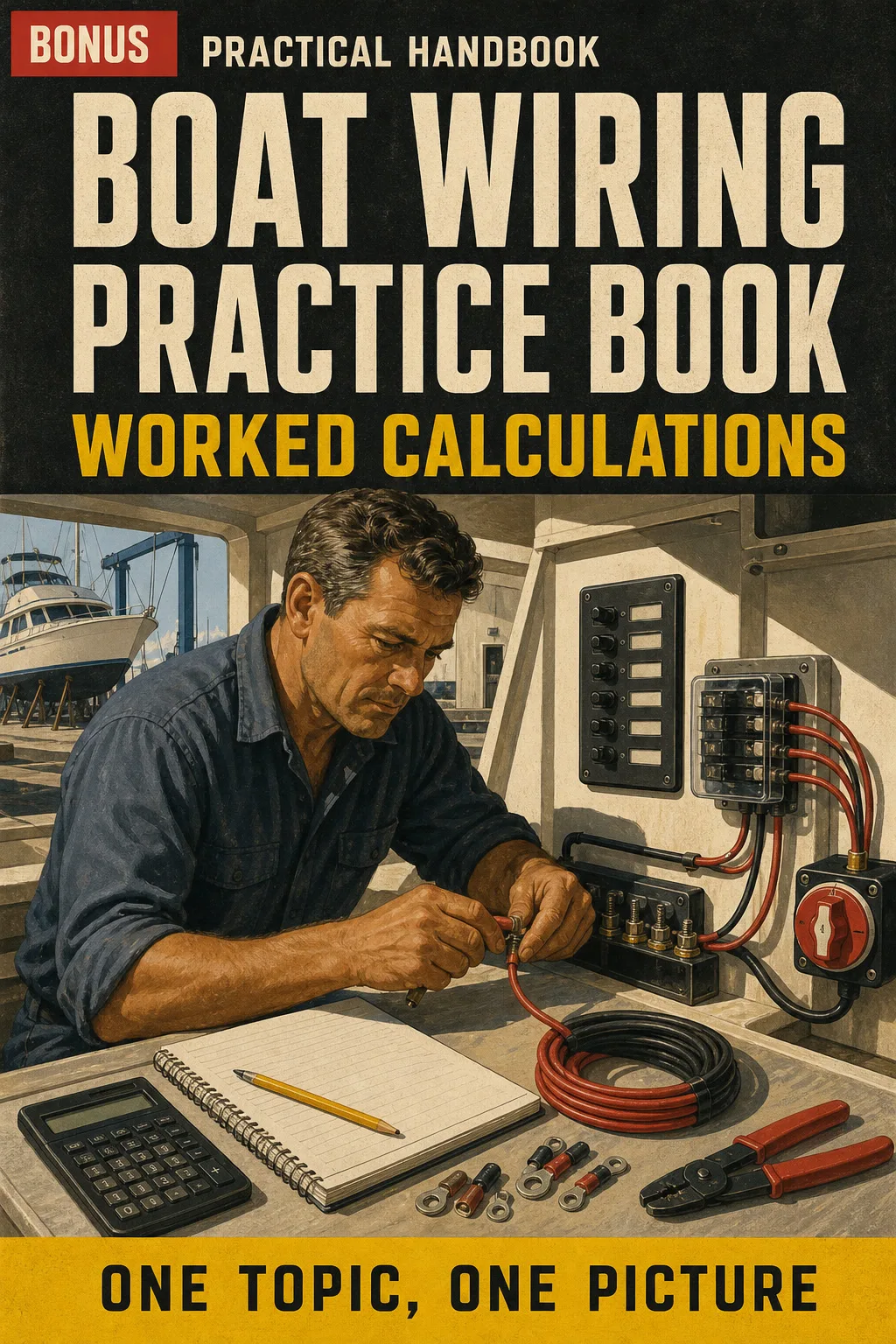
Plus: 2 Free Books

Boat Wiring Practice Book: Worked Calculations

BONUS 1: «Boat Wiring Practice Book: Worked Calculations»

Value on its own: US$ 17.90

Practise the sums you'll actually need on board (Ohm's law, battery bank size, cable size and voltage drop, solar output) with every answer worked out step by step.

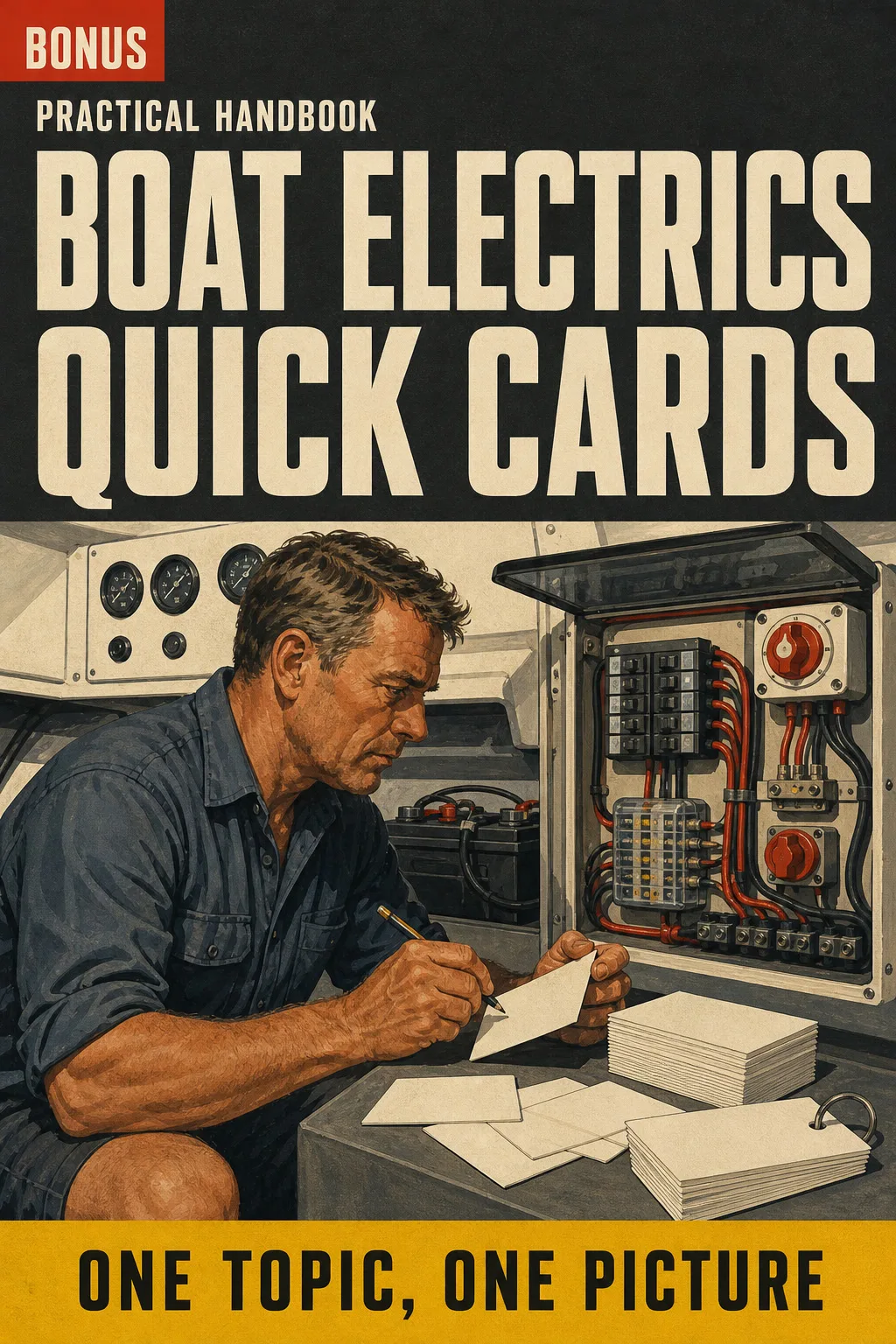
Boat Electrics Quick Cards

BONUS 2: «Boat Electrics Quick Cards»

Value on its own: US$ 14.90

Printable one-page cards to keep on the boat: the fault-finding order, the multimeter settings and the checks to do before you switch anything back on.

Boat Electrics Illustrated with 2 Free Books

  • Boat Electrics Illustrated: 66 illustrated pagesUS$ 63
  • BONUS 1: Boat Wiring Practice Book: Worked CalculationsUS$ 17.90
  • BONUS 2: Boat Electrics Quick CardsUS$ 14.90
  • High-resolution PDF to printIncluded
Total value US$ 95.80
YOUR PRICE:
US$ 27
You save US$ 68.80
YES, I WANT BOAT ELECTRICS ILLUSTRATED FOR US$ 27

📄 This is a digital PDF book sent to your email: nothing is printed or shipped.

Secure purchaseEncrypted payment30-day guarantee

PDF by email: We email you Boat Electrics Illustrated as a PDF, together with the two free books. It's a single payment: no installments, no extra charges.

Who This Book Is For

You're upgrading your boat

You're upgrading your boat

New batteries, a solar panel or the move to lithium: you plan it on the drawing first, in mm² and amps, before you buy a single part.

You've got a fault to find

You've got a fault to find

The bilge pump won't run or the start battery is flat again. You follow the same check order every time, from the battery to the load.

You already work at a boatyard

You already work at a boatyard

You touch 12 V and 24 V systems every day. Now the theory you picked up in bits sits in order, one page per topic, to keep at the bench.

Everything You Get Today

US$ 95.80US$ 27
YES, I WANT BOAT ELECTRICS ILLUSTRATED FOR US$ 27

📄 This is a digital PDF book sent to your email: nothing is printed or shipped.

30DAYS
GUARANTEE

30-Day Guarantee

Try Boat Electrics Illustrated for 30 days, bonus books included.

We refund everything if the file won't open, if the book isn't what you see here, if you were charged twice or if the email doesn't arrive. Just email us.

You pay once. No subscriptions.

Frequently Asked Questions

Is it for me if I've got a tinnie or a trailer boat, not a yacht?

Yes. The circuits are the same on a small boat, just fewer of them, and there's a page on the small-boat version. Bigger 24 V set-ups are covered too.

Where does the content come from?

It follows AS/NZS 3004.2 for recreational boats and the navigation-light rules of the state maritime regulators, described in our own words. AS/NZS 3000 is used only for the 230 V shore-power summary. All units are metric.

Is this official material?

No. It's an independent illustrated book. Standards and regulators are named only to say what the book follows.

Does it replace a marine electrician or a course?

No. It helps you understand your system and find faults calmly. 230 V shore-power work is for a licensed electrician, and lithium always goes by the manufacturer's data.

I've already changed batteries myself. Is it too basic, or too technical if I'm not an electrician?

It starts from the basics in one short part, then goes into what you'd actually do: sizing the house bank, voltage drop in mm², fuse placement, charging and fault finding. No electrical background needed, and nothing is padded for beginners.

When and how do I get it?

The book and the 2 free books come as PDFs by email, to the address you enter at checkout.

Do I have to pay every month?

No. It's a single payment.

Can I have it on paper?

It comes as a PDF, not a printed book. You can print the pages you need and keep them on the boat, or print the whole book.

How does the refund work?

You have 30 days. We refund everything if the file won't open, if the book isn't what you see on this page, if you were charged twice or if the email doesn't arrive: just email us.

Before You Close This Page

No more rereading forum threads that don't add up.

Cable, fuse and charging set-ups, drawn and clear.

You open the panel knowing where everything is.

Drawings make studying faster.

The book is right below.

One-time payment: US$ 27 · Guarantee: 30 days · PDF by email

YES, I WANT BOAT ELECTRICS ILLUSTRATED FOR US$ 27

📄 This is a digital PDF book sent to your email: nothing is printed or shipped.